
Kawasaki's June city council was about "wallets and preparedness": water rates, Typhoon No. 6, school lunch fees and Todoroki Ryokuchi (with what was decided later)
Published
Translated from Japanese. If anything differs, the Japanese version is correct.
Key points 30-second read
- At the Kawasaki City Council session held June 1–24, 2026 (the 2nd regular session), water rate increases and preparation for Typhoon No. 6 were the big topics. At the September session that followed, the council decided to raise water rates by 11% from April 2027 and 22% from April 2028.
- Typhoon No. 6 revealed problems with how school closures are decided and how evacuation shelters are prepared. A subsidy for installing "manhole toilets," which came up in the council, is accepting applications from Oct 19 to Dec 18, 2026.
- Measures against rising prices, such as free school lunches and shopping vouchers, were discussed, while the contract amount for the Todoroki Ryokuchi redevelopment rose from about ¥81.9 billion to about ¥91.3 billion.
What to do, and by when?
Deadline: Fri, Dec 18, 2026(47 days left (until Dec 18))
- By Dec 18, 2026: Apply for the manhole toilet installation subsidy (neighborhood associations, voluntary disaster prevention groups, apartment management associations and owners, private businesses, etc.; closes early if the budget runs out)
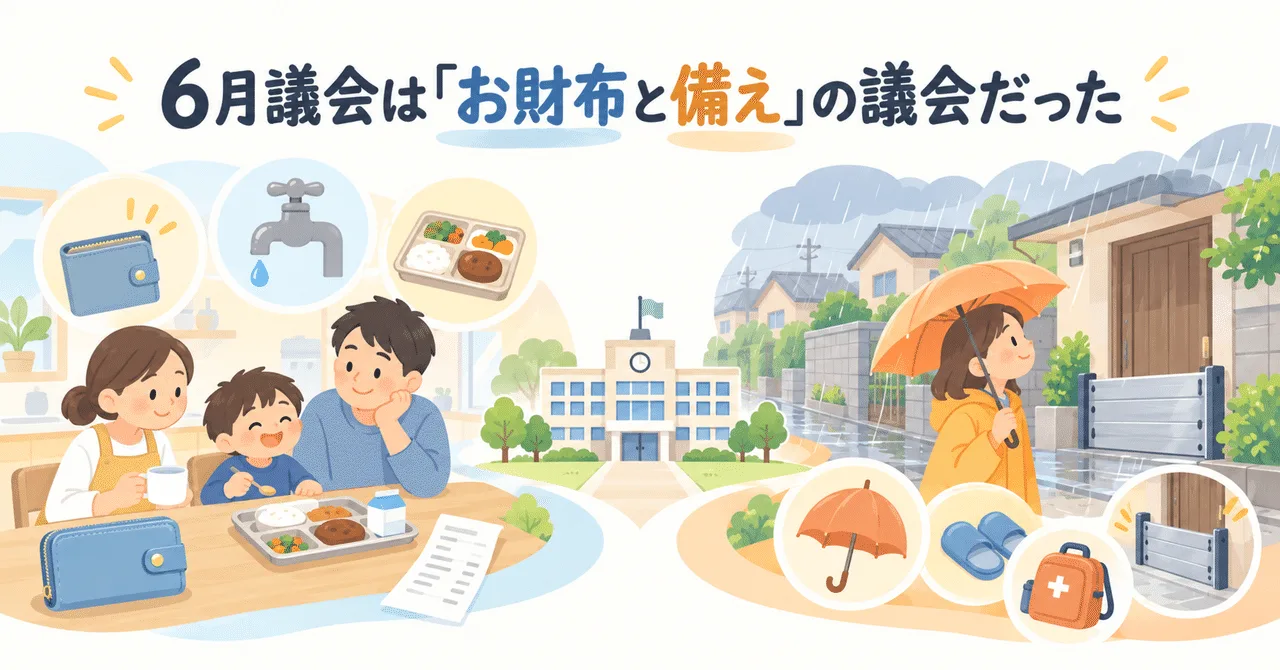
Image: Editorial team (note)
This is a shorter version, for this site, of our editorial team's note article that read the minutes of the Kawasaki City Council's 2nd regular session (June 1–24) from start to finish. There were 30 bills, group questions from 5 parliamentary groups and general questions from nearly 50 members. The discussion split into two big themes: "how much will we pay?" and "how do we prepare?" for typhoons and heavy rain.
What was decided after June (such as the results of the September session) has been checked against official city announcements and added.
Water rates: a rise in the low 20% range under study
The topic raised most often in June was the increase in water and sewerage charges. All 5 groups took it up in their group questions.
In June, against the advisory council's recommendation (36% for water, 37% for sewerage), the city said it planned "the low 20% range for water and the low 10% range for sewerage," and that it would decide by the September session when to raise sewerage charges.
After that, the September session (the 3rd regular session) decided the following. The ordinance raising water rates passed on Oct 13, 2026.
- Water rates: The increase is 22%, raised in two steps: 11% in fiscal 2027 and 22% from fiscal 2028. The Waterworks Bureau expects a typical household to pay about ¥210 to ¥499 more per month.
- The rate structure will also change. Charges will depend on the meter size, and the gap that makes the unit price rise the more you use will be narrowed. The "basic volume" system, which charges a flat ¥583 for up to 8 m³ a month, will be abolished.
- Sewerage charges: The increase in spring 2027 was put off. At a press conference on Aug 24, Mayor Fukuda said the city will consider what to do from fiscal 2028 onward.
- Supplementary resolution: A resolution was also passed asking the city to consider new reductions and support for kindergartens, nursery schools, certified child centers and others, and to keep explaining the change to residents and industries.
Why is an increase needed?
In June, the head of the water and sewerage business explained:
- The water business is expected to run a deficit from fiscal 2026 and run short of cash in fiscal 2027.
- Prices, interest rates and wages are rising, and the cost of replacing old water pipes and making them earthquake-resistant is growing.
- Large users such as factories have decreased. Businesses using more than 50 m³ a month fell from about 3,000 in 1989 to about 1,000 in 2019.
Council members asked for the increase to be spread over several years and for reductions for nursery schools and care facilities. The two-step increase and the supplementary resolution in September connect to these voices.
The council also heard that during big matches such as the soccer World Cup, Waterworks Bureau staff stand by and raise the water pressure at halftime and after the final whistle, because everyone goes to the toilet at the same time.
Lessons from Typhoon No. 6 and the new rain warnings
Typhoon No. 6, which made landfall in June, was the first typhoon handled under the new weather warning system (such as the "Level 4 heavy rain danger warning") introduced at the end of May. A linear rainband also formed on June 3, and areas in front of Kawasaki Station, including the Ginryugai shopping street, were flooded.
Is school closed?
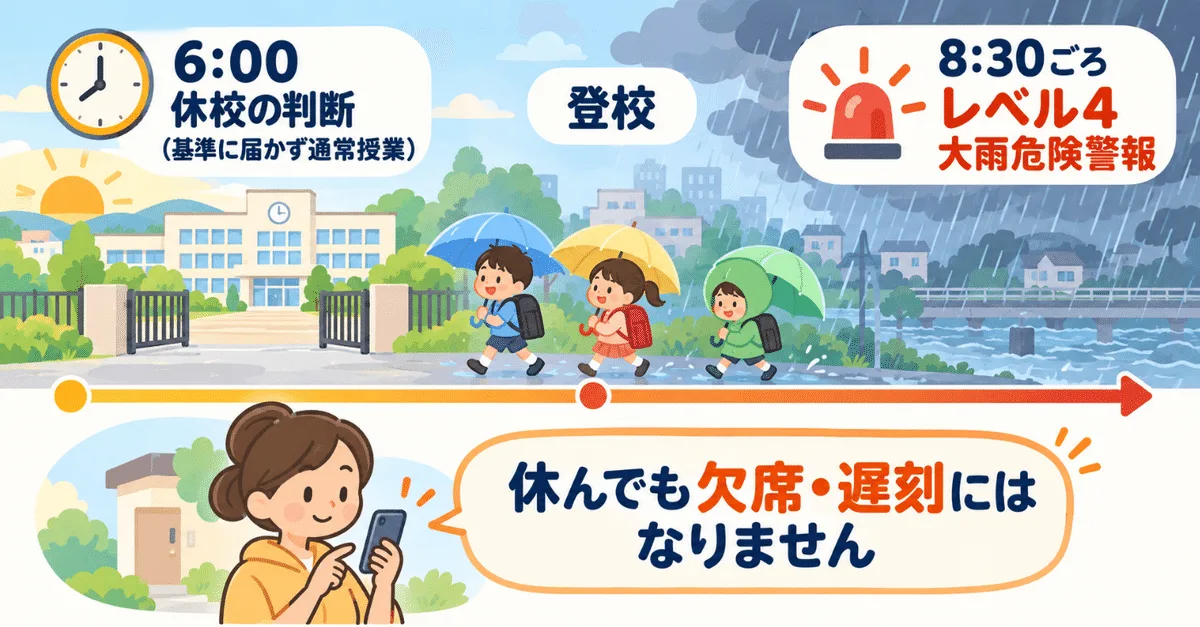
The rules for Kawasaki municipal schools are:
- If a "Level 4 heavy rain danger warning" is in effect at 6 a.m., all schools close.
- If it is a "Level 4 landslide danger warning," only schools that serve as landslide evacuation shelters close.
- Even if school is not closed, you may keep your child home. It does not count as an absence or lateness.
During Typhoon No. 6, the criteria were not met at 6 a.m., so schools ran as usual. But the warning that triggers closure was issued around 8:30 a.m., after the children had gone to school. Council members asked for decisions to be made the day before, and the city said it would look at how nearby cities handle it and listen to parents before reviewing the rules.
How many people brought slippers to the shelter?
During Typhoon No. 6, 69 shelters opened and 44 people evacuated. Only 1 of them brought indoor shoes.
Most shelters are school gyms, where outdoor shoes are not allowed in the living area. One council member suggested making it a habit to bring indoor shoes whenever you go to a gym. Slippers come off easily and can cause falls, so familiar indoor shoes are better.
What subsidies help prepare for flooding?
Both subsidies explained in June are now available.
- Flood barrier purchase subsidy: Covers half the cost (up to ¥100,000) of simple flood barriers placed at entrances to keep water out. Residents, apartment owners and management associations, and businesses can use it.
- Manhole toilet installation subsidy: A disaster toilet used by placing a seat or tent over a sewer manhole. It covers two-thirds of construction and purchase costs (up to ¥600,000). Eligible applicants include neighborhood associations, voluntary disaster prevention groups, apartment management associations and owners, and private businesses. Applications are accepted from Monday, Oct 19, to Friday, Dec 18, 2026, and close early if the budget runs out.
For details, see the guide handed out at the Crisis Management Headquarters on the 6th floor of the City Hall main building or at each ward office's crisis management desk, or check the city website.
Measures against rising prices, including school lunches
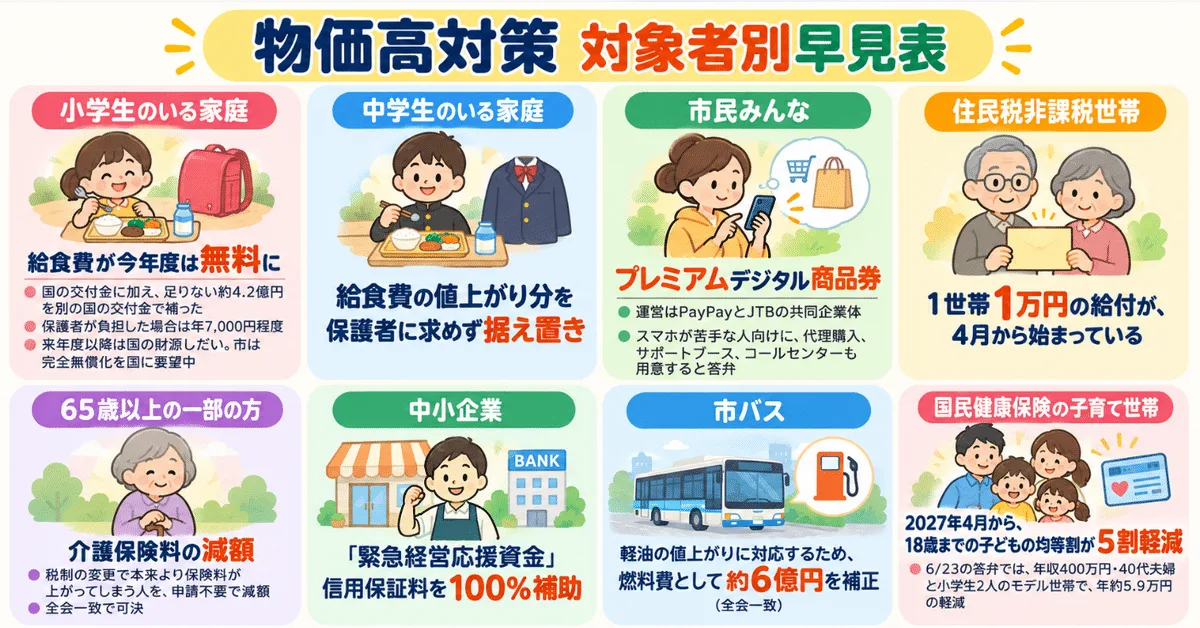
The measures against rising prices discussed in June are grouped by who they are for in the chart above. Elementary school lunches are free this fiscal year, and junior high school families will not be asked to pay the increase in lunch costs. Whether this continues next year depends on national funding.
For small and medium-sized businesses, the "emergency business support fund," under which the city fully covers the credit guarantee fee for companies whose sales or profits fell by 10% or more, passed unanimously. Applications run from July to the end of December.
We cover the premium digital shopping vouchers in our article on the second-round lottery results, and city bus fares in our article on the fare rising to ¥240 in April 2027.
Todoroki Ryokuchi up about ¥9.4 billion to about ¥91.3 billion
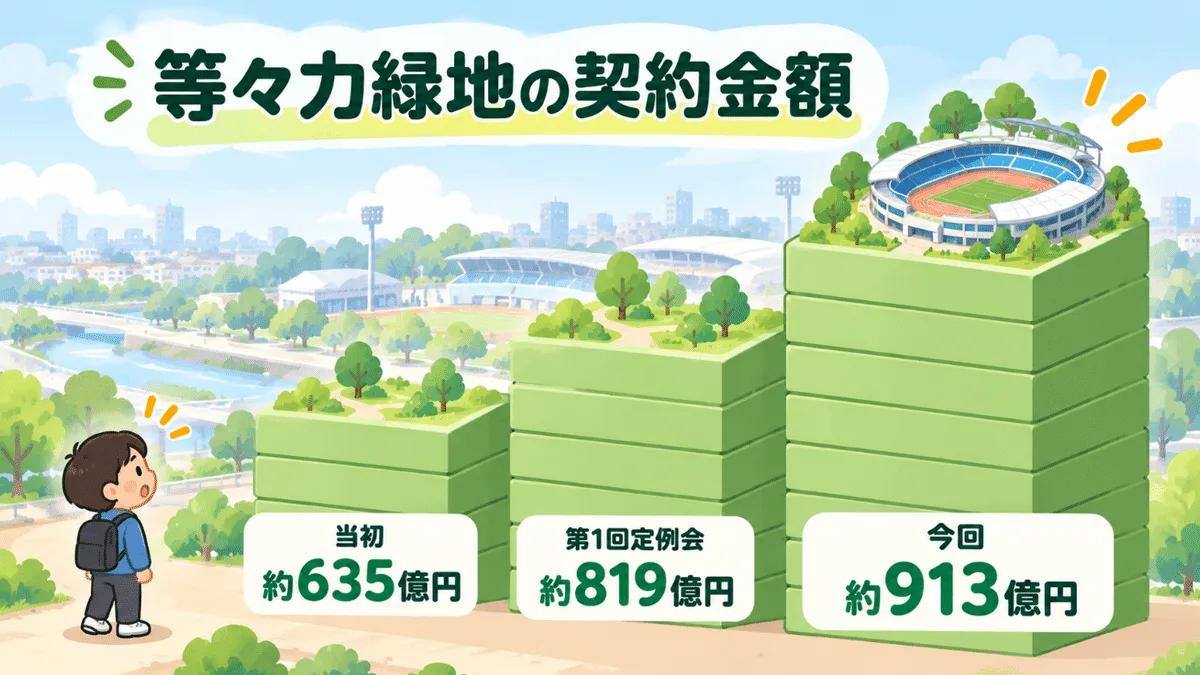
At Todoroki Ryokuchi in Nakahara Ward, a major project is rebuilding the athletics stadium, the arena and other facilities. Design, construction and operation are all entrusted to the private sector (PFI). The contract amount rose by about ¥9.4 billion, from about ¥81.9 billion to about ¥91.3 billion. The city cited rising prices, design changes and the cost of equipment for facilities that open in fiscal 2027.
The upper limits for tennis court and soccer field fees were also raised: about 1.7 times for tennis courts and about 3.7 times for soccer fields. Actual fees are set within this range by the designated manager with city approval. The vote passed by majority.
Other changes to daily life, including the end of an emergency info line
- The "Emergency Medical Information Center," which told callers which hospitals were open at night and on holidays, closed at the end of March and was merged into the prefecture's #7119 line.
- An ordinance to entrust the running of Saiwai Civic Hall and Saiwai Library to the private sector (designated management) passed. They will be closed for about two years for renovation.
- A proposal to cut the number of council seats from 60 to 53 was rejected, 5 for and 52 against.
- After the accident at Shimofuda Park in Tama Ward, about 1,200 parks are being inspected, including about 3,000 items that are not park facilities. The results are in our article on park safety checks.
- There were 105 private lodging (minpaku) notifications, 42 of them in Kawasaki Ward.
The exchanges taken from the minutes are summaries. Check the exact statements in the Kawasaki City Council minutes search system. The original note article includes more council members' opinions and figures that are left out here.
Sources
- 令和8年 第3回川崎市議会定例会会議結果(議案、議決結果等)(川崎市議会)
- 令和8年第3回定例会 議決結果(市長提出議案)(PDF)(川崎市議会)
- 議案第120号に対する附帯決議(PDF)(川崎市議会)
- 水道料金の改定案について(川崎市上下水道局)
- 市長記者会見記録(2026年8月24日)(PDF)(川崎市)
- マンホールトイレの設置を補助する制度を創設します(報道発表)(川崎市 危機管理本部)
- 簡易型止水板・雨水貯留タンクの購入を補助する制度を創設します(報道発表資料 PDF)(川崎市 危機管理本部)
- 川崎市議会 会議録検索システム(川崎市議会)
Share this article
 Send on LINE
 Share on X
 Share on Threads
Links sent on LINE open in your phone’s usual browser (Safari, Chrome, etc.).
Series · Part 1 of 2
Kawasaki City Council, made easy
- Part 1June council: wallets, prep
- Part 2Nursery rules change Dec 25
Who runs this site

Sky Hand
Runs Roots Lab. / UX writer
Designs UI and UX at a company, and runs and plans Roots Lab. Born in Fukuoka Prefecture.
See profile →You may also like
 50 students to meet city councilKawasaki City Council will hold a "Dialogue between High School Students and Kawasaki City Council Members" on Thursday, Dec 24, 2026, from 2 to 4 p.m., in the council chamber and other rooms on floors 22 to 24 of the Kawasaki City Hall main building.
- J-Alert test, Nov 11, 11 a.m.At 11 a.m. on Wednesday, Nov 11, 2026, there will be a nationwide test of "J-Alert," the system that sends emergency warnings about missiles, earthquakes and more. Kawasaki City will take part.
 Saiwai disaster drill, Nov 15The Saiwai Ward General Disaster Drill will be held at Furukawa Elementary School in Furukawa-cho, Saiwai Ward, from 9 to 11 a.m. on Sunday, Nov 15, 2026. No sign-up is needed.
- Care cost reduction error, 85 peopleKawasaki City announced that since April 2006 it had wrongly applied a program that lowers what users pay for nursing care run by social welfare corporations, reducing costs for people who should not have received that reduction.